

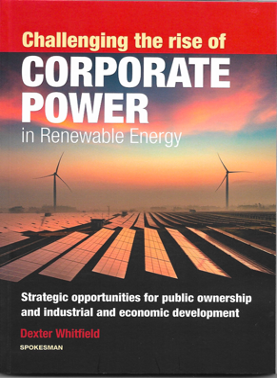
New Book: Challenging the rise of Corporate Power in Renewable Energy: Strategic opportunities for public ownership and industrial and economic development, by Dexter Whitfield, 26 January 2023.
A new dimension to the climate crisis has emerged as a result of the corporate domination of the renewable energy sector. The book details strategies for a democratic public future for renewable energy, protection of the built environment, nature and biodiversity. and demonstrates how decarbonisation, retrofitting, environmental adaptation and protection create new economic and industrial opportunities and generate significant good quality jobs.
One of the Top ten beach reads to ideologically warm up any long hot summer – Labour Hub. “Dexter Whitfield offers an alternative: a renewable energy programme rooted in saving the planet, not saving the fossil fuel industry from itself, More than enough to brighten up any beach read.”
https://labourhub.org.uk/2023/07/25/top-ten-beach-reads-to-ideologically-warm-up-any-long-hot-summer/
Scale of corporate domination
This book exposes how corporate interests dominate the renewable energy sector. These include private investment funds, venture capital funds, private equity funds and subsidiaries fossil fuel companies which are developers and owner-operators of wind farms, solar parks, battery storage, hydro, biomass and energy-from-waste projects. Market ideology dominates the sector and outsourcing is widespread.
These projects are bought and sold in a secondary market with development rights and ‘construction-ready status’, either as individual projects or as part of a portfolio of operational projects, often located in several countries. The analysis is based on the European Services Strategy Unit Global Renewable Energy Database which contains 1,622 transactions between 1st January 2019 and 31st December 2021.
Several publicly-owned companies in Norway, Sweden, Denmark, France, Germany, China, Romania and the Republic of Ireland are developers and owners of renewable energy assets, but the public sector accounts for 4% of renewable energy global generating power.
Deep structural flaws
- Private Equity Funds have carved out a pivotal role in financing and owning renewable energy assets – they acquired 369 renewable energy assets and sold 178 projects between 2019-2021.
- 41 major renewable energy companies registered in tax havens, were involved in 264 transactions to acquire assets whilst a further 47 transactions involved the sale of renewable energy assets. The use of tax havens to avoid or reduce corporate taxation increases corporate profits but reduces tax revenue for governments.
- A sample of 20 private renewable energy companies paid their shareholders £8.75bn (US$10.7bn) in dividends in the study period reflecting a high level of profiteering in the sector.
- Despite the wide criticism and failure of many Public Private Partnership projects, the World Bank and regional development banks continue to promote the PPP model for renewable energy projects in developing economies with 2.928 PPP projects signed since 1997 plus 839 fossil fuel projects.
Public ownership, values and economic, social and environmental justice
The book sets out the attributes of public goods and ten public service principles and a Core Public Values Framework is based on five key pillars – quality, effectiveness, equality, efficiency and sustainability – that are essential in providing public infrastructure and services to meet social, economic and environmental needs and human rights. Not only are the five pillars inter-dependent but they are also dependent on inputs, working methods, impacts and outcomes, outputs and monitoring and evaluation.
Challenging corporate domination of renewable energy
Whitfield describes various ways in which the corporate domination of the renewable energy sector can be challenged, for example by eliminating companies that use tax havens; by requiring improved democratic accountability and continuous community and trade union participation in planning and service delivery; by direct investment in place of auctions; by intervention in private sales of assets. He sets out a strategy to significantly increase public ownership of renewable energy including via remunicipalisation, new national and local public sector organisations and direct investment in renewable energy projects, decarbonisation and retrofitting.
Spokesman Books – https://spokesmanbooks.org/ (Paperback £18.00, ePub £10.00).
Additional data available – https://www.european-services-strategy.org.uk/public-ownership
Who will control renewables?
Regan Scott review of Challenging the Rise of Corporate Power in Renewable Energy in The Spokesman 154 (pages 116-117) 2023.
“Dexter Whitfield’s new book on corporate power in the renewable energy world is unique in looking ahead and in depth at the implications of high global financial capitalism’s penetration of the undoubtedly much needed and welcome renewable energy industries.”
https://www.european-services-strategy.org.uk/wp-content/uploads/2023/06/Regan-Scott-Review-1.pdf